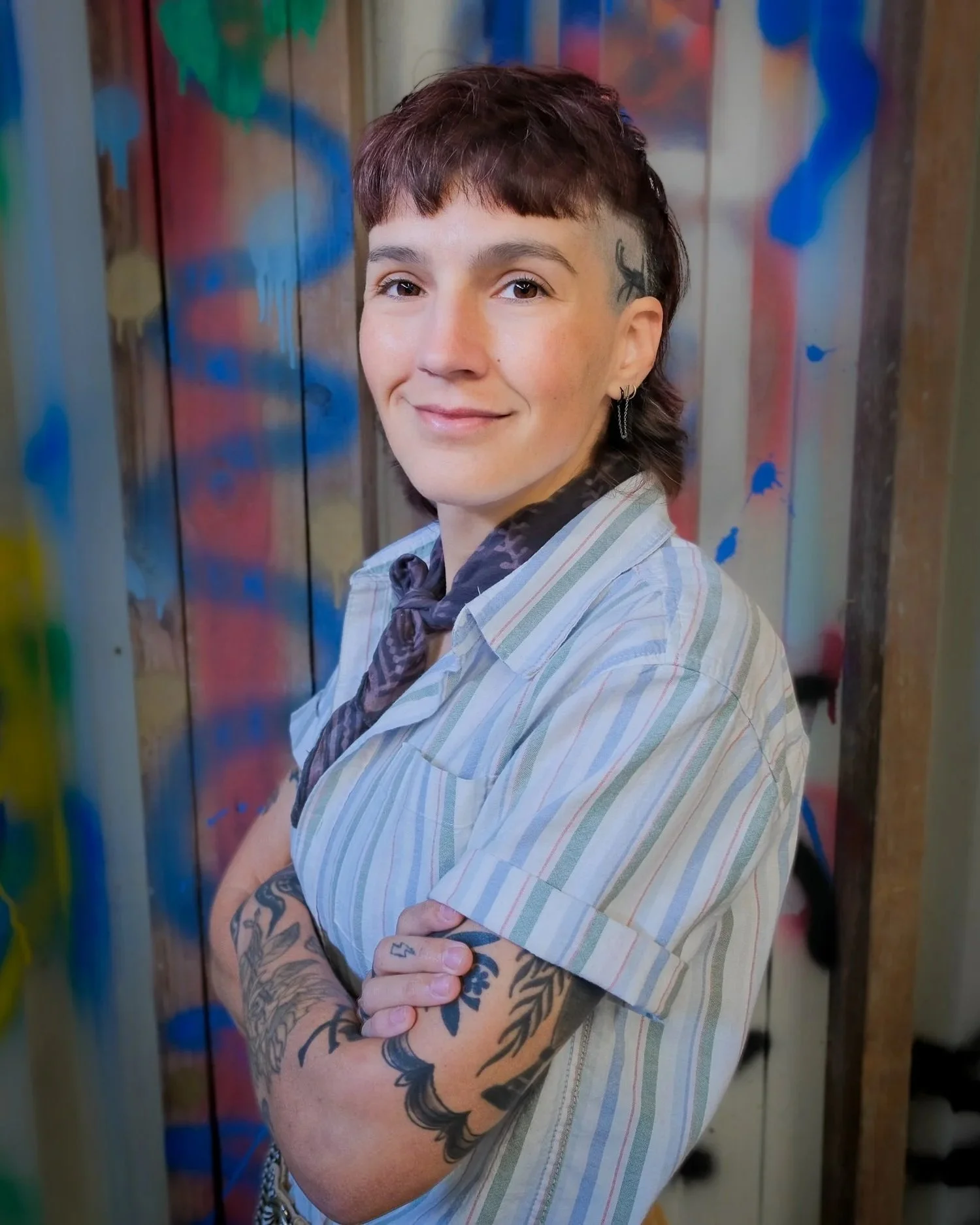
Caroline Hatfield is a visual artist whose practice utilizes sculpture, installation, and mixed media to engage with materiality and environment. After completing a Sculpture BFA at The University of Tennessee, they earned an MFA in Interdisciplinary Studio Art from Towson University. Hatfield’s work has been reviewed or included in numerous publications, such as The Washington Post and Alluvian Environmental Journal. They have exhibited artwork nationally and internationally at venues such as The Mint Museum in Charlotte, NC, The Delaware Contemporary in Wilmington, DE, and the CICA Museum in Gimpo, South Korea. Recent solo exhibitions include "Foresights and Futures" at VisArts in Rockville, MD and “Celestial/Terrestrial” at Columbia College in South Carolina. Among Hatfield’s awards and honors, they are a recipient of the Trawick Contemporary Art Prize (2018), a South Arts Cross-Sector Impact Grant (2020), and a Mississippi Arts Commission Visual Artist Fellowship Grant (2023). As Assistant Professor and Area Coordinator of Sculpture at Mississippi State University, they live and work in Starkville, MS.
Through sculpture, installation, and images, I explore our perception of landscape as medium and nature as commodity. With moon rocks, Martian terrain, coal waste, driftwood, and natural sciences samples, I express methods of observation, extraction, and exploration.
Two directions of interest have emerged in my recent projects. One focuses on near-future climate engineering and extra-terrestrial resource extraction, such as lunar or asteroid mining. This speculative, celestial branch of my work feels closest to my earlier influence of environment, extraction, and science/SF. The other thread of my recent work is terrestrial, transformative, and poetic — dealing with natural forms and earth processes. Trees (and iterations of vines, roots, stumps, and petrified wood) have become a recurring motif as found objects, cast forms, or representative elements. Organic growth, decay, and time are embedded in the symbolism of these sculptures. Driftwood represents erosion by natural forces, whereas a tree stump suggests human intervention. Similarly, water, fossilization, and limestone in my recent installation, “EPIGRAPH,” connect to a deep, geological past that considers the earth a record and text. Yet, it is a language that frames our present environmental concerns. In my work, I seek to engage with the rich contradictions at the intersection of the celestial and terrestrial, the speculative and tangible, natural and unnatural.